

Mensuration Formulas: The study of geometric figures and their measurements falls within the field of mensuration in mathematics. It deals with dimensions such as area, surface area, volume, length, and shape, among others. Measuring geometrical forms that fall into the 2D and 3D shape categories is the main focus of measurement.
Mensuration Formula in Maths
Mensuration Formulas
Mensuration Formulas for 2-D Figures
| Mensuration Formulas for 2-Dimensional Figures | ||
| Shape | Area | Perimeter |
| Circle | πr² | 2 π r |
| Square | (side)² | 4 × side |
| Rectangle | length × breadth | 2 (length + breadth) |
| Scalene Triangle | √[s(s−a)(s−b)(s−c), Where, s = (a+b+c)/2 | a+b+c (sum of sides) |
| Isosceles Triangle | ½ × base × height | 2a + b (sum of sides) |
| Equilateral Triangle | (√3/4) × (side)² | 3 × side |
| Right Angled Triangle | ½ × base × hypotenuse | A + B + hypotenuse, where the hypotenuse is √A²+B² |
| Parallelogram | base × height | 2(l+b) |
| Rhombus | ½ × diagonal1 × diagonal2 | 4 × side |
| Trapezium | ½ h(sum of parallel sides) | a+b+c+d (sum of all sides) |
Mensuration Formulas for 3-D Figures
| Mensuration Formulas for 3-Dimensional Figures | |||
|---|---|---|---|
| Shape | Area | Curved Surface Area (CSA)/ Lateral Surface Area (LSA) | Total Surface Area (TSA) |
| Cone | (1/3) π r² h | π r l | πr (r + l) |
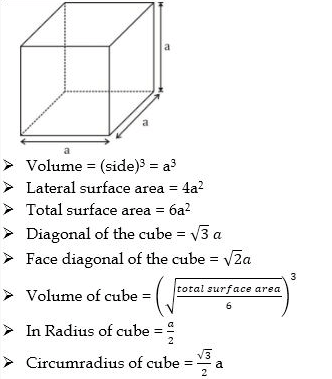
| Cube | (side)³ | 4 (side)² | 6 (side)² |
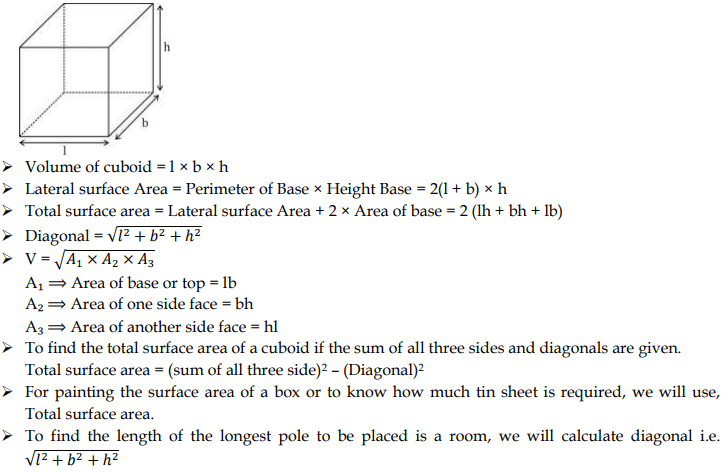
| Cuboid | length × breadth × height | 2 height (length + breadth) | 2 (lb +bh +hl) |
| Cylinder | π r² h | 2π r h | 2πrh + 2πr² |
| Hemisphere | (2/3) π r³ | 2 π r² | 3 π r² |
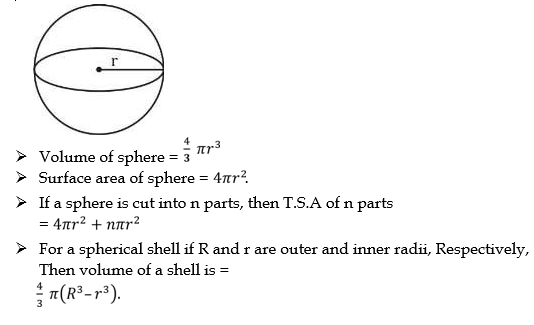
| Sphere | 4/3πr³ | 4πr² | 4πr² |
Differences between 2-dimensional and 3-dimensional Figures
| 2-Dimensional Figures | 3-Dimensional Figures |
| As the name suggests, a 2D shape means that it will have only 2 dimensions which are length and breadth. | Here, a 3D shape means that this figure will have 3 dimensions, which are length, breadth, and height. |
| For 2D shapes, we can calculate 2 things i.e. area and perimeter. | For 3D shapes, we can calculate their volume, total surface area, and curved/lateral surface area. |
| 2D shapes are flat as they do not have depth and also, these cannot be held physically because of the lack of depth. | 3D shapes contain a depth so they can be held physically and are not flat like 2D shapes. |
| Example: Square, Rectangle, Triangle, Circle, etc. | Example: Cone, Cylinder, Sphere, Cube, Prism, Pyramid, etc. |
Mensuration Formulas PDF
Mensuration Formulas PDF 1- Click to Download
Mensuration Formulas PDF 1- Click to Download
Mensuration maths formulas for all 2-D and 3-D figures are discussed below in detail.
1. Cube Formula
2. Cuboid Formula
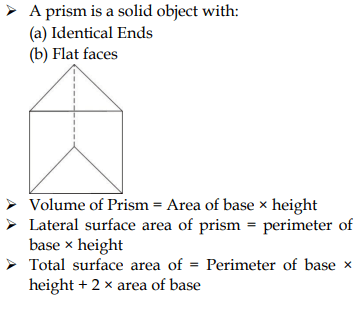
3. Prism Formula
4. Sphere Formula
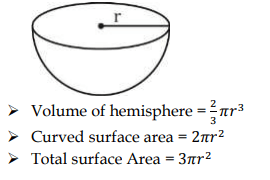
5. Hemisphere Formula
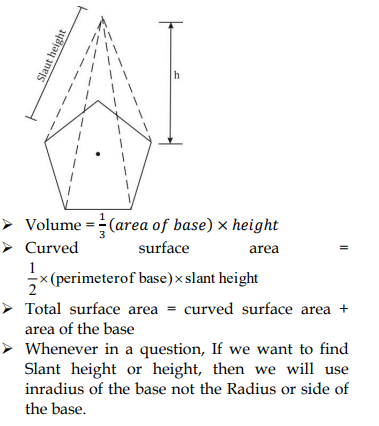
6. Pyramids Formula
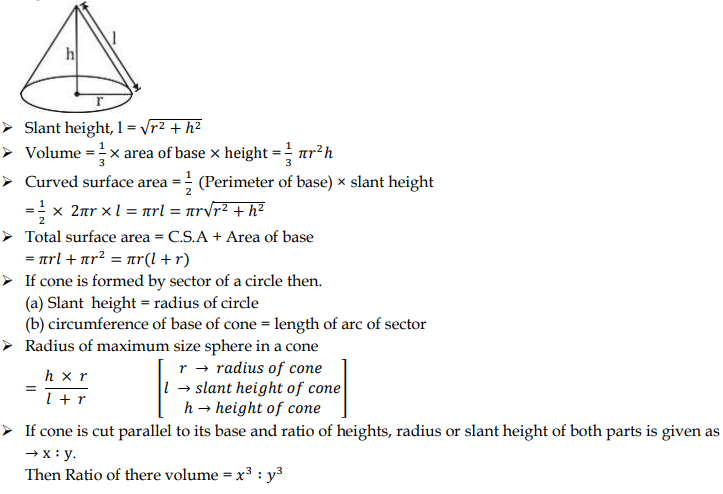
7. Right Circular Cone Formula
8. Right Circular Cylinder Formula
Important Terms Related to Mensuration Formula
Before we get into the formulas for mensuration, let's understand some important terms:
- Perimeter: This is the measure of the continuous length around the boundary of a shape, and it's measured in units like meters (m) or centimeters (cm).
- Area: It is the surface enclosed within a shape and is measured in square units like square meters (m²) or square centimeters (cm²).
- Volume: This measures the space occupied by an object and is expressed in cubic units such as cubic meters (m³) or cubic centimeters (cm³).
- Curved/Lateral Surface Area: This is the measurement of the curved surface in a shape and is expressed in square units like square meters (m²) or square centimeters (cm²).
- Total Surface Area: This represents the overall surface area of a shape, including the top and bottom portions, and is measured in square units like square meters (m²) or square centimeters (cm²).
Mensuration Questions with Solutions
Q1. Find the area of a rhombus whose diagonals are of lengths 9 cm and 7.2 cm.
Solution: Now, d1=9 cm, d2=7.2 cm where d1 and d2 are the lengths of diagonals of a rhombus.
Area of rhombus formula is ½ (d1xd2)
Therefore, area of the given rhombus = ½ x 9 x 7.2 cm² = 32.4 cm²
Note: Here, the value of π is either considered as 22/7 or 3.14, r means radius, and h means height.
Q2. A rectangular paper of a width of 10 cm is rolled along its width and a cylinder of a radius of 18 cm is formed. Find the volume of the cylinder. (Take π=22/7)
Solution: A cylinder is formed by rolling a rectangle of 10 cm about its width. The radius of the cylinder is 18 cm and the width of the paper becomes the height.
Height of the cylinder, h = 10 cm and Radius of the cylinder, r = 18 cm
Now, volume of the cylinder, V = πr²h = (22/7) x (18)² x 10
= 10,183 cm³
Hence, the volume of the cylinder is 10183 cm³.
Q3. A circle has a radius of 21 cm. Find its circumference and area. (Use π = 22/7)
Solution: We know, Circumference of circle = 2πr = 2 x (22/7) x 21 = 2 x 22 x 3 = 132 cm
Area of circle = πr² = (22/7) x (21)² = 22/7 x 21 x 21 = 22 x 3 x 21
Area of a circle with a radius, of 21cm = 1386 cm²
Q4. The length, width, and height of a cuboidal box are 30 cm, 25 cm, and 20 cm, respectively. Find its area.
Solution: Here, l- 30 cm, b= 25 cm, and h= 20 cm
Total surface area = 2 (lb +bh +hl)
= 2 (30 × 25 + 25 × 20 + 20 × 35)
TSA = 2( 750 + 500 + 700) = 3900 cm²
Q5. A rectangular piece of paper 11 cm × 4 cm is folded without overlapping to make a cylinder of the height of 4 cm. Find the volume of the cylinder.
Solution: The length of the paper will be the perimeter of the base of the cylinder and the width will be its height.
Circumference of base of cylinder = 2πr = 11 cm
2 x 22/7 x r = 11 cm
r = 7/4 cm
Volume of cylinder = πr²h = (22/7) x (7/4)² x 4 = 38.5 cm³
Q6. The tangents drawn at points A and B of a circle with Centre O, meet at P. If ∠AOB = 120° and AP= 6cm, then what is the area of triangle (in cm²) APB?
Solution:
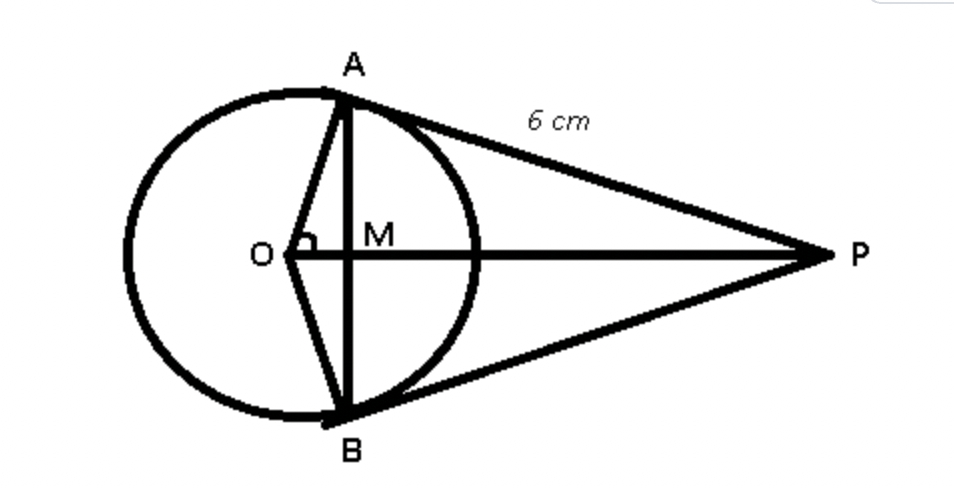
Given ∠AOB = 120° and AP= 6cm and ∠OAP = 90°
∠AOP= ½∠AOB = 120/2 = 60°
In △AOP, >tan (∠AOP) = AP/OA
=> tan 60° = 6/OA
=> √3 = 6/OA
=> OA = 6/√3 = 2√3 cm
Thus, area of △AOP = ½ x (OA) x (AP)
=> ½ x (2√3) x (6) = 6√3 cm² ……………….. (i)
Now, in △AOM
=> sin(∠AOM) = AM/OA
=> sin 60° = AM/2√3
=> √3/2 = AM/2√3
=> AM = 3 cm
Similarly OM= √3 cm
Thus, area of △AOM = ½ x (OM) x (AM)
=> ½ x (√3) x (3) = 1.5√3 cm² ……………….. (ii)
Now, ar(△AMP) = ar(△AOP) - ar(△AOM)
=> 6√3 -1.5√3 = 4.5 √3 cm²
∴ ar(△APB) = 2ar(△AMP)
= 2 x 4.5√3 = 9√3 cm²
Q7. The total surface area of a hemisphere is 166.32 cm², find its curved surface area?
Solution: Let radio of hemisphere = r cm
Total surface area of hemisphere = 3 π r² = 166.32 ……………….. (i)
Multiplying equation (i) by ⅔
=> ⅔ x 3 π r² = ⅔ x 166.32
=> Curved surface area of hemisphere = 2 π r² = 2 x 55.44 = 110.88 cm²
Q8. If G is the centroid and AD, BE, and CF are three medians of the triangle with 72 cm², then the area of triangle BDG is:
Solution: The area of the triangle formed by any two vertices and centroid is ⅓) times the area of △ABC.
Also, the median divides the triangle into two equal areas.
So, the area of △BDG = 1/6 times of △ABC
=> 1/6 x 72
=> 12
Q9. The perimeters of two similar triangles ABC and PQR are 156 cm and 46.8 cm respectively. If BC= 19.5 cm and QR= x cm, then the value of x is?
Solution: (△ABC) Perimeter/ (△PQR) Perimeter) = BC/QR
=> 15.6/46.8 = 19.5/x
=> x = 46.8 x 19.5 / 156
=> 5.85 cm
Q10. A solid metallic sphere of radius 10 cm is melted and recast into spheres of radius 2 cm each. How many such spheres can be made?
Solution: As, V = 4/3 π r³
The volume of the big sphere = n x volume of a small sphere
=> 4/3 π (10)³ = n x 4/3 π (2)³
=> n = 125
Conclusion
Mensuration is a wide and practical issue, making it both an interesting and challenging topic to cover. Additionally, a lot of formulas are present, which some students find challenging to remember. Well, if you practice a few questions on the subject on a daily basis and review all the formulas, this should be simple. We hope you will find our Mensuration Formulas essay to be useful and instructive. Keep checking back for more articles like this one.


0 Comments